Gofilms4u Hindi Exclusive Best
All About Digital Photos

Gofilms4u Hindi Exclusive Best

While GoFilms4U is popular for its "free" access, it operates under a piracy model

The digital entertainment landscape has shifted dramatically over the last decade. High-speed internet access and affordable smartphones have made movie streaming a daily habit for millions. In regions like South Asia and among the global diaspora, the demand for Bollywood, regional Indian cinema, and Hindi-dubbed Hollywood content is at an all-time high.

The premier destination for major Bollywood releases, massive domestic television serials, and live cricket streaming. gofilms4u hindi exclusive

In recent years, cinema from the South of India (Tollywood, Kollywood, Mollywood, and Sandalwood) has gained unprecedented popularity across India and globally. Blockbusters originally filmed in Telugu, Tamil, Malayalam, or Kannada are frequently dubbed into Hindi. For audiences who prefer Hindi, these dubbed versions are highly sought-after "exclusives." 3. Uncut and Extended Editions

Free, unauthorized streams are notorious for low-quality video, mismatched audio tracking, broken links, and constant buffering. In contrast, official platforms offer 4K ultra-HD resolution, Dolby Atmos sound, and seamless multi-device synchronization. How to Enjoy Hindi Exclusives Safely and Legally While GoFilms4U is popular for its "free" access,

To understand why this specific keyword sequence is popular, it helps to look at consumer behavior in the digital age. What is Gofilms4u?

In India, the Cinematograph Act of 1952 and the Copyright Act of 1957 prohibit camcording and piracy. Accessing or distributing content from Gofilms4u is a non-bailable offense. The Indian government has blocked thousands of such sites under Section 69A of the IT Act. While an individual viewer is rarely jailed, the act of seeding (uploading while downloading) can lead to heavy fines. For audiences who prefer Hindi, these dubbed versions

Copyright infringement harms the creative ecosystem. When movies are pirated or distributed without authorization, the directors, actors, writers, and technicians who worked on the project lose their rightful earnings. Furthermore, many countries have strict digital anti-piracy laws, and accessing unauthorized streams can result in penalties or warnings from Internet Service Providers (ISPs). 4. Poor User Experience

The next time you see a link promising "gofilms4u hindi exclusive," remember what lies behind the flashy interface. The real exclusive is the security, quality, and legality that comes with choosing a legitimate streaming service.

| Platform | Key Hindi Content | Model | | :--- | :--- | :--- | | | Original Hindi series ("Sacred Games," "Delhi Crime"), Bollywood films, stand-up specials. | Paid Subscription | | Amazon Prime Video | Amazon Originals ("Mirzapur," "The Family Man"), new Bollywood releases, classic films. | Paid Subscription | | Disney+ Hotstar | Extensive library of Bollywood, Hindi-dubbed South Indian films, live sports, and HBO content. | Freemium/Paid | | ZEE5 | Massive collection of ZEE original content, web series, Bollywood movies, and regional cinema. | Freemium/Paid | | SonyLIV | Sony TV shows, original web series ("Scam 1992"), Bollywood movies, and live sports. | Freemium/Paid | | JioCinema | Free for Jio users, offering a vast library of movies and TV shows. | Free (with ads) | | MX Player | A free, ad-supported platform with a wide variety of original shows, Bollywood movies, and web series. | Free (with ads) |

 
Changing the DPI

DPI vs PPI - please note that references here to DPI (Dots Per Inch) actually means PPI (Pixels Per Inch). I continue to use DPI since that's still how many people (incorrectly) understand it. And with some software (i.e. most scanning software), you'll still see DPI used where PPI is what is actually meant. DPI (meaning printer dots per inch) is essentially an obsolete term. But it's still in very common use as a term to mean PPI. See What is DPI. At some point I'll change all my DPIs to PPIs - but that's another project for another day :-)


If you've come here after reading my article "The Myth of DPI" you'll already know that DPI has nothing to do with digital image resolution or quality. However, some people and places who are still ignorant of that fact (many graphics designers, magazines and print shops) still insist of getting a photo with an internal setting of ___DPI (usually 300 DPI) even when the photo's pixel resolution is sufficient to print the photo at the required PPI. The easy solution (rather than trying to educate them about real digital photo resolution) is to simply change the DPI setting of your image to whatever they want and send it along to them.

You may also wish to change the DPI so that the image will default size to the intended print dimensions when loaded into a word processor or desk top publishing program. For instance, if you want to set a 1500 pixel wide photo so that it will default to a 4 inch print dimension, then change the DPI setting of the photo to 375 DPI (1500 pixels divided by 4 inches = 375 pixels per inch).

The trick when changing the DPI is to do it without resizing (resampling) your image in the process. You want to change the DPI while retaining the original pixel dimensions (the real digital resolution) of the photo. I'll provide three examples, one using Adobe Photoshop (Windows & mac) and the other two using the free programs XnView (Windows, Linux & mac) and Irfanview (Windows).

Note that this procedure will not change the digital photo in any way other than to alter the internal DPI setting. The size and resolution of the digital image will be unchanged.

XnView Method
    gofilms4u hindi exclusive
    note that the "Resample Image" box is UNCHECKED and that the "Print Size" has been set to 300
  1. Open a folder with images and select an image to show full view.
  2. Select the "Image > Resize" menu option (not the "set DPI" option)
  3. In the image size dialog window, deselect the "Resample Image" checkbox (make sure there is no checkmark in that box).
  4. In the "Resolution" box type in 300 (or whatever DPI you want)
  5. Click the "OK" button
  6. Your image DPI has now been set to whatever you want (leaving the pixel dimensions of the image unchanged).
  7. Save this photo with a new name - I suggest adding a -300dpi extender (i.e. "345-2365-300dpi.jpg") to identify this new DPI image.
  8. See note below when saving to JPEG format
Earlier versions of XnView had a bug in which the DPI change wasn't recognized by programs such as Adobe Photoshop. This was fixed in 2009, so any current version is fine. There is a direct "set DPI" option, but you have to make sure to adjust both the X and Y to identical values (only the X value will be recognized by Photoshop, I'm not sure what happens with the Y, hence best to stick with the "Resize" dialog).
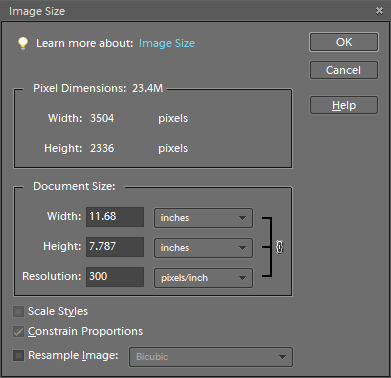
Adobe Photoshop Method
    adobe - change dpi
    note that the "Resample Image" box is UNCHECKED
    and that the "Resolution" has been set to 300
  1. Load your image into Adobe Photoshop (or Photoshop Elements).
  2. Select the "Image > Image Size" menu option (may be "Image > Resize > Image Size" in Photoshop Elements).
  3. In the image size dialog window, deselect the "Resample Image" checkbox (make sure there is no checkmark in that box).
  4. In the "Resolution" box type in 300 (or whatever DPI you want)
  5. Click the "OK" button
  6. Your image DPI has now been set to whatever you want (leaving the pixel dimensions of the image unchanged).
  7. Save this photo with a new name - I suggest adding a -300dpi extender (i.e. "345-2365-300dpi.jpg") to identify this new DPI image.
  8. See note below when saving to JPEG format

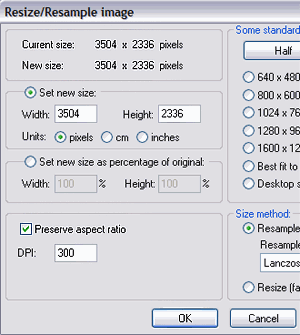
Irfanview Resize Image Dialog Box
Irfanview Method
  1. Load your image into Irfanview
  2. Select the "Image > Resize/Resample" option
  3. In that dialog window you'll see a specific DPI data box
  4. Simply enter whatever DPI you want without adjusting anything else in that dialog window.
  5. Click on the "OK" button
  6. Your image DPI has now been set to whatever you want (leaving the pixel dimensions of the image unchanged).
  7. Use "Save As" to save this photo with a new name - I suggest adding a -300dpi extender (i.e. "345-2365-300dpi.jpg") to identify this new DPI image.
  8. See note below when saving to JPEG format

Saving to JPEG - please note that JPEG is a digital photo format that uses variable compression - that is, you can change the compression. Your camera should (if you have it set correctly) be using low compression (highest quality). To emulate this when doing a "save as" from a photo program, choose a compression of about 95 (Adobe Quality 10+).

If you are using XnView, when you do a JPEG save, click on the "Options" button to give you the JPEG save dialog and move the slide towards "Best" to whatever number (i.e. 95) you wish. Using Irfanview, when you do a "Save As" in JPEG format, note the dialog box with the JPEG options - move the slider to 95 (or higher if you wish) for best image quality. With Adobe Photoshop (incl. Elements) - choose quality 10 or higher in the dialog box that comes up when you do a Save As in JPEG format.

A verification is to check the image filesize (in kilobytes or megabytes) of your copy of the photo against the original digital photo. They probably won't be identical, but should be close. If there is a big discrepancy in filesize then you've done something wrong.

Other Programs

Other photo programs are going to have a similar process. The key is to make sure that the image IS NOT being resampled (pixel resized) when the DPI is changed. As long as the pixel dimensions remain unchanged, your new DPI photo will be identical to your original photo, only the internal DPI setting of the photo will have been changed. Your print shop, graphics designer or magazine should be happy campers with your "new higher DPI" image.


Home   •   What Is | Filetypes | Colour Models | Acronyms and Nomenclature | Frequently Asked Questions (FAQ)   •   Storage   •   Digital Labelling | Visible Captioning   •   What Is DPI | Myth DPI | Change DPI   •   Changing Size   •   Print Shops | Arithmetic of DPI | FAQ | Photoshop Dialog Box   •   Home Printing | Print Shops   •   Geotagging   •   Scanning   •   Digital Images and Genealogy | Make Your Photos Last Forever | Camera or Scanner | Copying Old Photos | Workflow Examples | Visible Captioning | Choosing a Camera | Print Longevity | Sending Photos to Relatives

Comments: send me email:

URL: www.rideau-info.com/photos/changedpi.html
© 2003- Ken W. Watson